
Asphalt Pavement Association of Indiana
Porous Friction Course in
By Rebecca S. McDaniel, P.E., Ph.D.
Open graded friction courses (OGFC) got a bad rap in some parts of the country in the 1980s although they performed well in other areas, especially in the South. Designed with 10 to 15 percent air voids, OGFCs proved to be rut resistant, and their open texture provided good friction and reduced splash and spray. But in more northern climates, these surfaces had a tendency to clog with road grime and the abrasives used for snow and ice control.
Because of some bad experiences with early OGFCs, many states were understandably reluctant to try the new generation of OGFCs, often called permeable European mixes (PEM) or porous friction courses (PFC). The new OGFCs have higher void contents, in the range of 18-22 percent, thanks to a strongly gap-graded aggregate gradation. In addition, these mixes typically include modified binders and/or fibers to help hold the binder in the open aggregate structure.
Voids in a surface mix provide channels to carry water away from the tire, improving wet weather friction, and reducing splash and spray. The voids also attenuate sound and disrupt some of the tire/pavement noise generation. Early OGFC mixes were primarily intended to be rut resistant, due to the stone on stone contact within the mix and also to provide good friction, not necessarily to reduce noise.
The high void content of newer permeable surfaces is intended to help keep the mix open. The suction created as tires traverse the pavement is supposed to expel fine material from the pores, preserving the pavement’s texture. In addition, the high void content provides improved noise reduction properties.
Field test section
So, in August 2003, the Indiana DOT and the Federal Highway Administration allowed the placement of a field test section of PFC on I-74 east of
The OGFC and SMA mixes were composed of steel slag aggregate with 10 percent manufactured dolomitic sand. The SMA also included 10 percent mineral filler. Cellulose fiber was added to the PFC at 0.3 percent and to the SMA at 0.1 percent by weight to prevent draindown. Both mixes contained a PG76-22 binder. The major difference was in the air void content; the PFC was designed at 23 percent air voids while the SMA was designed at 4 percent.
Construction of the OGFC was accomplished using conventional paving equipment. An MTV was used to improve the ride quality and reduce segregation for both the OGFC and SMA. Compaction was accomplished with two steel-wheeled rollers. Only one pass of each roller was needed to seat the OGFC and SMA.
Surface performance
Performance of the OGFC has been monitored for five years by the
Since one of the primary concerns was that the surface would clog and the open texture would be lost, monitoring changes in texture over time was critical. This was accomplished using a laser-based device called a Circular Track Meter (CTM). The CTM measures texture at over 1,000 points around a circle 284 mm (11.2 in) in diameter. The CTM was periodically used to measure the texture at various points in and between the wheelpaths in each test section. The results from measurements in the wheelpaths, where the greatest changes would be expected to occur, are summarized in Table 1. This data shows that the texture has not changed significantly; the OGFC is holding its own against the traffic and climate.
Friction in the test sections was periodically measured using a Dynamic Friction Tester (DFT). This companion to the CTM measures friction in the same footprint as the CTM when a spinning disk, supported on three rubber sliders, slows from a tangential velocity of 80 kph (55 mph) to a complete stop. The favorable friction performance of both the OGFC and the SMA has been confirmed by annual measurements made by the Indiana DOT Office of Research and Development using their standard towed friction trailer.
Results from the DFT and the CTM are combined to determine the International Friction Index (IFI). Changes in surface texture and/or wearing of the aggregates could be reflected in changes in the friction level. Friction levels are known to vary seasonally, but an overall downward trend in friction could indicate deterioration of the surface characteristics. As the results in Table 1 show, this change has not been observed. This is likely due in part to the use of steel slag aggregate, but also reflects the adequate surface texture of both mixes.
Noise Benefits
Immediately after construction, the OGFC yielded sound pressure levels that were about 5 decibels lower than the SMA for passenger cars and small trucks. This was a significant reduction in noise. The question, of course, was how long that benefit would last.
Since the interstate has been opened to traffic, the statistical pass-by method has been used to assess the sound level. In this method, microphones are set up at a specified distance from the roadway and the sound generated by individual vehicles in the traffic stream is measured. The speed of each measured vehicle is recorded with a radar gun so that the data can be adjusted to account for variations in speed. Both passenger cars and large trucks, which can generate different levels of noise, are measured in this technique.
Figure 1 shows the trend in sound pressure levels for both surface types over time. This graph clearly shows that the OGFC continues to provide excellent sound reduction capabilities even after five years under heavy interstate traffic and the
Observations
In addition to the measured surface properties, visual observation of the surface shows that no significant distress has occurred since the time of construction. The surface has proven durable with no signs yet of the end of its service life.
During rain events, the reduction in splash and spray on the OGFC section is obvious; visibility is greatly improved. Water is not observed standing on the surface, as may be seen on the SMA during heavy rains.
The difference in sound is also obvious inside the vehicle, as well as outside where the sideline noise levels have been measured. When you cross onto the OGFC, you suddenly realize how loud the radio is! When standing alongside the road, collecting data, conversations can be carried on in normal voices. These non-technical observations further illustrate the beneficial effects of the PFC.
The five-year performance history of this test section demonstrates that porous friction courses can hold their own against heavy traffic and a Midwestern climate. No significant changes have been observed in the surface texture, friction or sound pressure level. The action of tires on the pavement apparently does help keep the voids open, so that they can provide channels for water and the attenuation of sound, preserving the frictional and the noise reduction properties of the surface. Porous friction courses are another tool in the tool box for the design of safe, quiet and durable asphalt surfaces.
Rebecca S. McDaniel, P. E., Ph.D., is the Technical Director, North Central Superpave Center, Purdue University in West Lafayette, Ind.
Table 1. Surface Texture and Friction in Wheelpaths over Time
|
Date |
PFC |
SMA |
||
|
Texture (MPD, mm) |
IFI |
Texture (MPD, mm) |
IFI |
|
|
9/03* |
1.37 |
0.36 |
1.17 |
0.28 |
|
8/05 |
1.52 |
0.45 |
1.10 |
0.45 |
|
11/05 |
1.40 |
0.41 |
1.10 |
0.45 |
|
10/06 |
1.37 |
0.37 |
1.03 |
0.39 |
|
4/07 |
1.48 |
0.43 |
1.08 |
0.47 |
|
7/07 |
1.44 |
0.41 |
0.98 |
0.43 |
|
9/07 |
1.38 |
0.40 |
1.03 |
0.42 |
|
8/08 |
1.48 |
0.42 |
1.08 |
0.42 |
*Measured before opening to traffic.
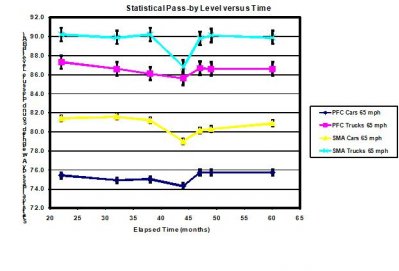
Figure 1 Sideline Noise over Time